
DPM Failure and Rising Moisture Under New Floors
Investigating issues like cupping or lifting? A DPM failure and rising moisture under new floors is a common cause, often mistaken for a product or fitting fault.
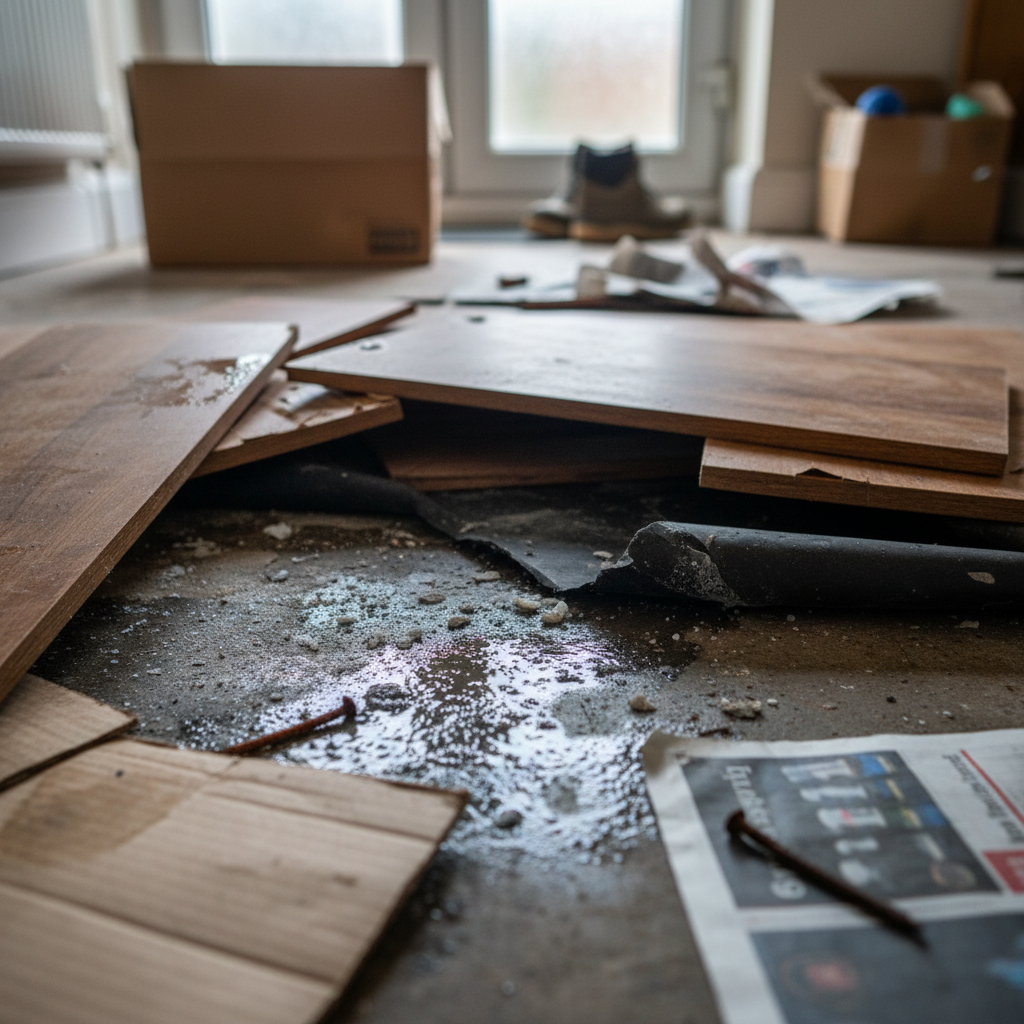
It is a scenario I encounter frequently. A homeowner has a beautiful new floor installed, perhaps an engineered wood or a quality laminate. For the first few months, everything seems perfect. Then, slowly, changes appear. Boards may begin to cup at the edges, lifting slightly to create a washboard effect. Joints might start to peak, or the entire floor could feel bouncy in places. The immediate suspicion often falls on the flooring material itself, but in my experience, the root cause is very often a case of DPM failure and rising moisture under new floors.
When I am called to a site like this, the homeowner is usually caught between the retailer and the installer. The retailer suggests a leak or a site-related issue, while the installer might point to a manufacturing defect in the boards. My role is to cut through the opinion and establish the facts using a methodical, evidence-based process.
Distinguishing fault: product, fitting, or sub-floor?
On any inspection, my first task is to consider all possibilities. A floor covering can fail for one of three general reasons: a manufacturing defect, an installation error, or an unsuitable site condition. They can sometimes present with similar symptoms, which is where the confusion starts.
A manufacturing defect is an inherent fault in the product. This could be, for example, a weakness in the bonding between layers of an engineered board, causing it to delaminate. An installation error is a failure to follow the manufacturer's instructions or the relevant British Standard. A common example is leaving an insufficient expansion gap around the perimeter, which prevents the floor from expanding and contracting naturally with changes in humidity.
Then there is the third category: an unsuitable site. This almost always relates to the sub-floor, and moisture is the most frequent culprit. No matter how well-made the flooring is, or how expertly it is fitted, if it is laid on a damp sub-floor without adequate protection, problems are almost inevitable. This is where we must investigate for a potential DPM failure and rising moisture under new floors.
An inspector's approach to the problem
At the time of inspection, my process begins with a non-destructive survey. I assess the overall environment of the room, taking note of ambient temperature and relative humidity. I then use a calibrated electronic moisture metre, typically a pinless one, to scan the surface of the floor. This can help to build a picture of where moisture is most concentrated. A higher reading towards the centre of a room and lower readings at the edges, for instance, can be an indicator that moisture is coming from below, rather than a surface spillage.
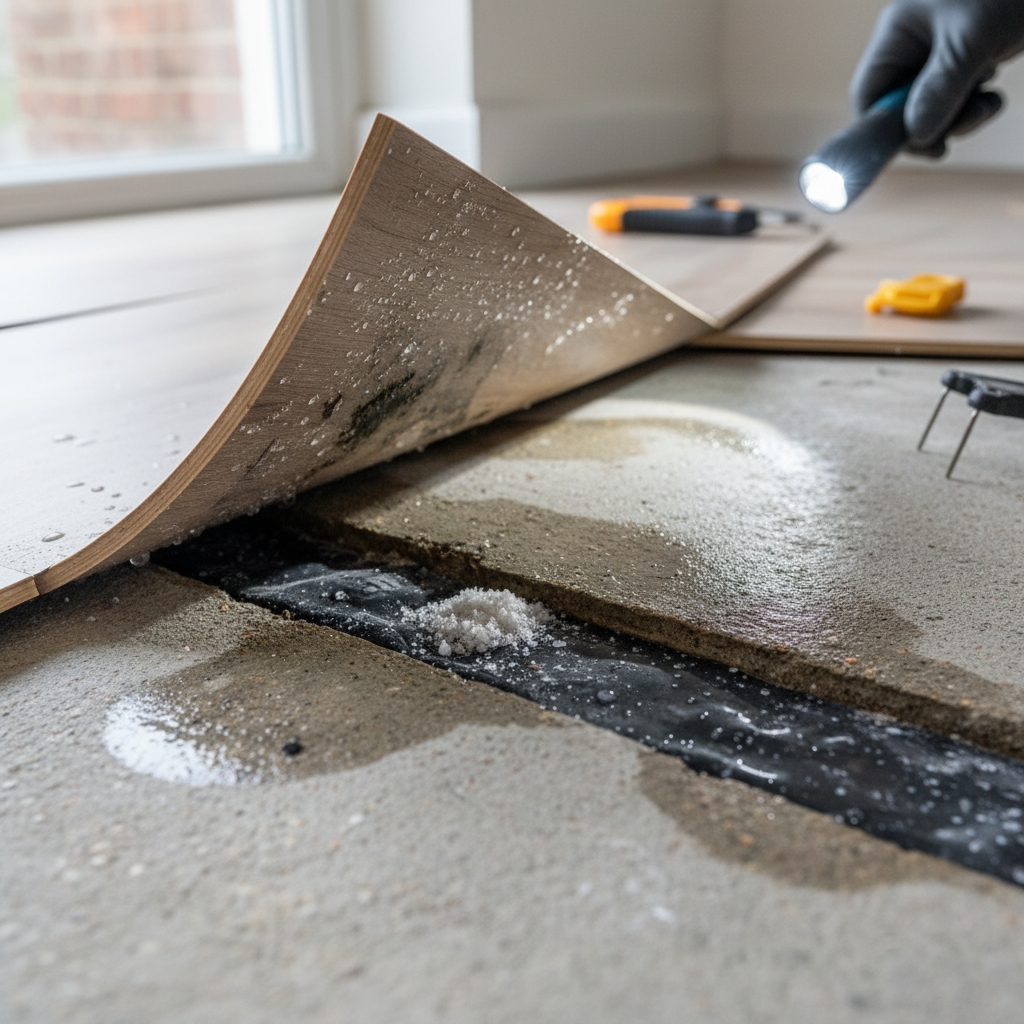
However, surface readings alone are not conclusive. To get a definitive answer, it is necessary to examine the sub-floor itself. This usually involves carefully lifting a board, often in an inconspicuous area like under a sofa or in a doorway. Once the sub-floor is exposed, its condition can be assessed directly. It is at this stage that the presence, or absence, of a suitable Damp-Proof Membrane (DPM) can be confirmed.
The role of the Damp-Proof Membrane
A DPM is a layer intended to stop the passage of moisture. In flooring, its job is to isolate the floor covering from the sub-floor, particularly from concrete or screed sub-floors. A DPM can be a physical sheet of plastic (typically a heavy-gauge polythene) or, increasingly, a liquid that is applied to the sub-floor and cures to form a waterproof barrier.
British Standards such as BS 8203 (Code of practice for installation of resilient floor coverings) and BS 5325 (Code of practice for installation of textile floor coverings) provide clear guidance on the need for moisture testing before installation. Concrete slabs, especially new ones, hold vast quantities of water and can take many months to dry to an acceptable level. Even older slabs can be problematic if the original structural DPM beneath the concrete is missing or has failed. Without correct testing and the subsequent installation of a DPM where required, moisture from the slab will slowly migrate upwards, be absorbed by the flooring, and cause it to swell, cup, and distort.
How we test for DPM failure and rising moisture under new floors
The most reliable method for determining if a concrete sub-floor is dry enough is to measure its Equilibrium Relative Humidity (ERH). This is done using a digital hygrometer, which is sealed to a pre-prepared area of the sub-floor. It is left in place, often for at least 24 hours, to allow the air in the sealed space to reach equilibrium with the moisture in the slab.
This test provides a clear, numerical reading of the sub-floor's moisture condition. Flooring manufacturers specify the maximum ERH value their products can tolerate. If an installer fits a floor onto a slab that exceeds this value without first applying a suitable DPM, it constitutes an installation error. In my professional opinion, the failure to perform and document such a test before proceeding is a significant finding. The presence of these test results, or the lack thereof, often forms a key part of my final report.
Ultimately, a floor that is cupping or lifting is displaying a symptom. A proper investigation does not just look at the symptom; it finds the cause. More often than not, that cause lies hidden, and a systematic inspection is the only way to bring it to light.
When to call an independent inspector
If you are in a dispute over a failing floor and suspect a sub-floor issue, an independent report can provide the evidence-based clarity you need. I provide a professional, impartial service across the whole of the UK. My reports are trusted by retailers, manufacturers, and legal professionals, and are produced to a standard recognised by the Furniture and Home Improvement Ombudsman.
I offer a range of inspection levels to suit your situation and budget. You can learn more about what is included in my Silver, Gold, and Diamond packages here. If you would like to discuss your specific case and how I might be able to assist, please do not hesitate to get in contact.
Have a flooring problem of your own?
We are independent UK flooring inspectors. Tell us about your case and we will recommend the right inspection package, with a fixed fee in writing before any work begins.