
Five Questions to Ask Any Flooring Installer Before They Start
An independent inspector's guide. Here are five questions to ask any flooring installer before they start to prevent common, costly flooring failures.

I am often called to inspect a new floor that has failed within months. The homeowner is distressed, the retailer is often defensive, and sometimes the original installer cannot be reached. In my experience, the root cause is almost always an issue that was present, but not addressed, before the floor was even laid. A few simple checks can prevent most of these problems. Based on the issues I see week in, week out, here are five questions to ask any flooring installer before they start work.
1. Have you tested the sub-floor for moisture?
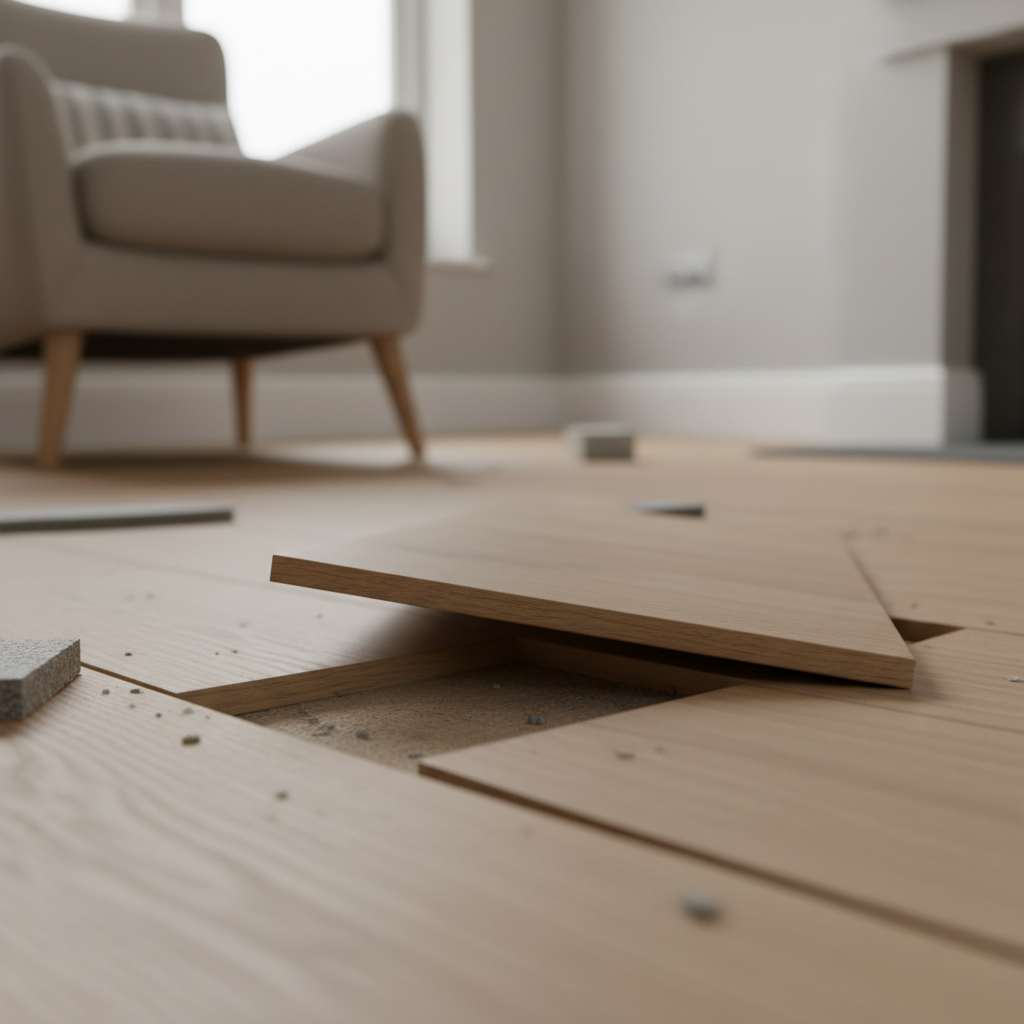
This is, in my professional opinion, the single most important check. I have attended countless sites where a beautiful new wood or vinyl floor is lifting, bubbling or cupping. The cause is frequently moisture vapour transmission from the concrete or screed sub-floor beneath. It can look and feel perfectly dry to the touch, but still hold enough residual moisture to cause catastrophic failure.
A professional installer should arrive with a moisture metre. For concrete floors, the definitive test according to British Standard BS 8203 is a digital hygrometer. The installer should drill a small hole, place a probe, and take a reading of the Relative Humidity (RH) within the slab itself. If this reading is above the specified limit for the chosen flooring and adhesive (typically 75% RH, but it varies), the floor should not be laid. To proceed would be a considerable risk.
One common myth I hear is, ‘the underlay has a damp-proof membrane, so it will be fine’. This is rarely the case. These built-in membranes are typically for resisting small amounts of moisture, not for holding back a sub-floor with a high RH reading. Another is, ‘it’s an old house, a bit of damp is normal’. This is not an acceptable reason to ignore industry standards. The sub-floor must be confirmed as suitably dry before work commences.
2. Is the sub-floor sufficiently flat and sound?
The quality of your new floor is entirely dependent on the quality of the surface it is laid upon. A new floor will not hide an uneven sub-floor; it will accentuate it. Over time, high spots will cause premature wear, and low spots can cause boards to flex and click.
An installer should check for what the industry calls 'surface regularity'. They can do this with a long straightedge (often two metres) placed across the floor. Any significant gaps between the straightedge and the sub-floor indicate that it is not flat enough. British Standards provide clear guidance on acceptable tolerances.
If the sub-floor is uneven, it should be corrected with a suitable smoothing or levelling compound. If it is a wooden sub-floor, loose boards must be secured. Too often, I see installations where this step has been skipped to save time or money. The subsequent report then has to note that the failure is due to inadequate preparation, not a fault with the product. Do not accept the excuse that ‘the thickness of the new floor will even it out’. It will not.
3. How will the new flooring be acclimatised?
Many flooring materials, particularly solid wood, engineered wood, and luxury vinyl tiles (LVT), need to adjust to the temperature and humidity of the room they are being installed in. This process is called acclimatisation.
Failing to acclimatise the product correctly is a frequent cause of problems. If wood flooring is installed without acclimatisation, it may expand or contract excessively once it adjusts to the room's environment. This can lead to unsightly gaps appearing between boards, or a more serious issue called ‘tenting’, where the floor lifts up in the middle. I have seen floors lift several inches off the sub-floor due to this pressure.
The installer should know the manufacturer’s specific requirements. This usually involves leaving the packs of flooring in the room of installation for a set period, often 48 to 72 hours or more, before fitting begins. When I am called to inspect a failed wood floor, one question I ask is whether the product was acclimatised. Often, no evidence can be provided that this was done.
4. Where will you leave expansion gaps, and how large will they be?
For any ‘floating’ floor installation (like laminate, engineered wood, or some LVT), a gap must be left around the entire perimeter. This includes around walls, door frames, kitchen islands, and radiator pipes. This expansion gap allows the whole floor to expand and contract naturally with changes in room temperature and humidity.
This gap is then covered by the skirting boards or a small trim called a scotia. A common installation error is fitting the floor too tight to the wall, or fixing skirting boards down so tightly they pinch the floor and prevent movement. When the floor expands, it has nowhere to go and can lift or buckle.
A recurring myth I have to address is when a retailer blames a failure on a small spill, suggesting water damage is the cause. At the time of inspection, I will lift a board or remove a piece of trim to examine the perimeter. If I find no evidence of an expansion gap, my report will conclude that the likely cause of the buckling is thermal expansion, not a minor spill. A professional installer should be able to explain exactly how they will ensure adequate provision for expansion.
My final thoughts on the five questions to ask any flooring installer before they start
Asking these questions does not make you a difficult customer. It makes you an informed one. A professional, competent installer will have no issue answering them. They will welcome your engagement and be able to show you their moisture metre, their straightedge, and explain their process. If an installer seems evasive or dismisses these points as unimportant, I would view that as a significant warning sign. A successful installation is a partnership between the customer, retailer, and fitter, and it begins with ensuring the site conditions are correct before a single board is laid.
When to call an independent inspector
If you have already had a floor installed and are experiencing problems, an independent inspection report can provide a clear, evidence-based assessment of the situation. My findings are impartial and based on industry standards, providing a factual basis for your discussions with the retailer or installer. In my experience, a detailed report is often the key to reaching a resolution.
I cover the whole of the UK and am a registered and trusted inspector for the Furniture and Home Improvement Ombudsman. My reports are used in dispute resolution and can be produced for legal proceedings if required. For more information on the inspection process, please see my packages or contact me to discuss your specific issue.
Have a flooring problem of your own?
We are independent UK flooring inspectors. Tell us about your case and we will recommend the right inspection package, with a fixed fee in writing before any work begins.