
Why Engineered Wood Floors Cup and Crown: An Inspector's View
An independent inspector explains the causes of cupping and crowning in engineered wood, focusing on sub-floor moisture, acclimatisation, and installation standards.
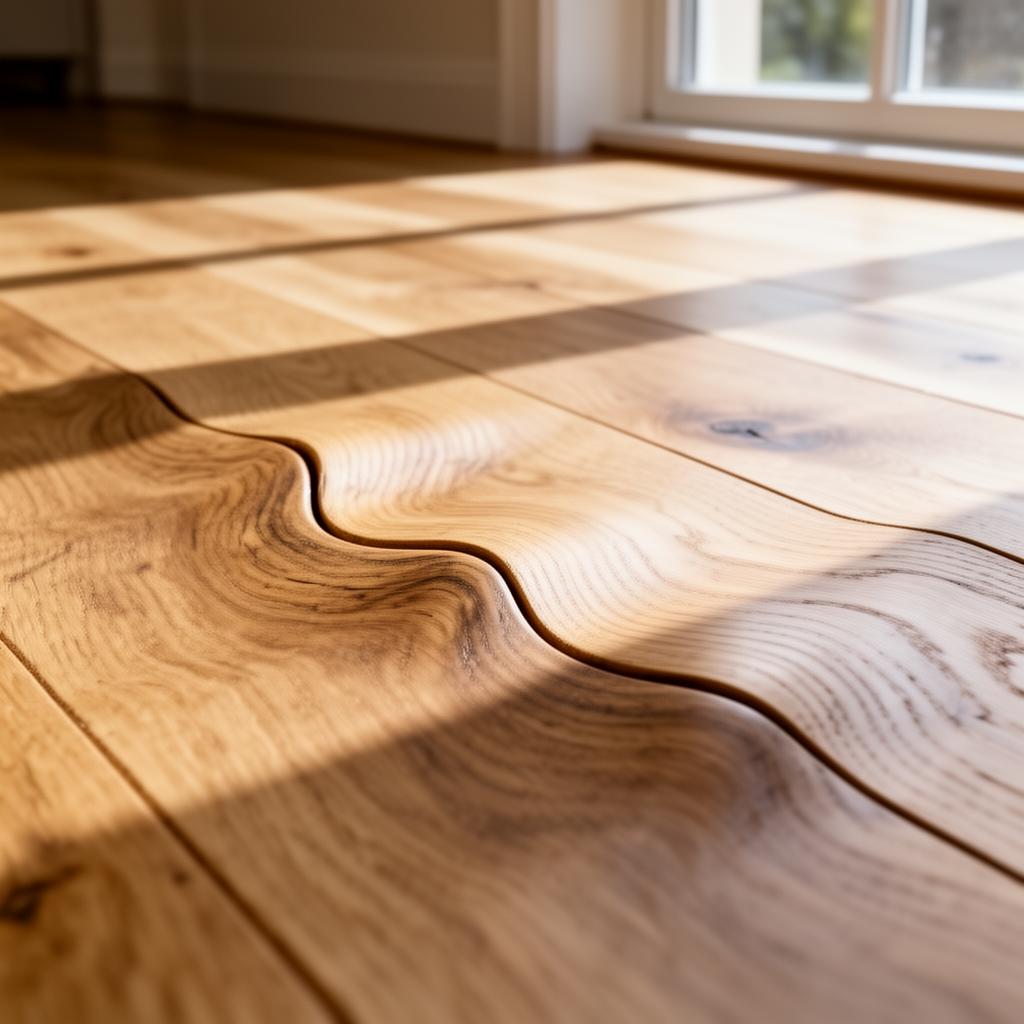
It is a situation I am called to inspect frequently. A homeowner has a new engineered wood floor installed and for the first few weeks, or sometimes months, everything appears correct. Then, slowly, a washboard effect develops across the room. The edges of the individual boards become raised, creating a series of shallow troughs. This is known as cupping, and it is almost always a symptom of a moisture imbalance within the floor itself.
What are cupping and crowning?
Cupping is the term for flooring boards that are concave in shape. The edges of the board are higher than the centre. Visually, it can create a scalloped or rippled appearance across the surface of the floor, which is most obvious when light shines across it at a low angle.
Crowning is the opposite condition. The centre of each board is raised higher than its edges, creating a convex shape. In my experience, crowning is less common than cupping and often occurs as a consequence of an incorrect attempt to rectify a cupped floor. Both conditions are indicators that the wood has moved due to changes in its moisture content.
The usual suspect: sub-floor moisture
Wood is a hygroscopic material. This means it absorbs and releases moisture from and to its surrounding environment. Engineered flooring is constructed in layers to provide stability and reduce this movement, but it is not immune to it.
Cupping occurs when there is a moisture differential through the thickness of the board. Specifically, it happens when the underside of the board is wetter than the topside. The wood fibres on the damp underside expand, and this expansion forces the edges of the board to lift upwards.
The most common source of this moisture is the sub-floor. A new or existing concrete slab that has not been allowed to dry sufficiently is a frequent cause. British Standard BS 8203 provides clear guidance on the assessment of sub-floor moisture. On site, I conduct tests to establish the moisture condition of the sub-floor. This may involve using a surface electronic moisture meter for an initial indication, followed by placing a sealed hygrometer to measure the relative humidity (RH) of the slab over a period of time. These quantitative findings are critical.
Without a suitable and correctly installed damp-proof membrane (DPM), this moisture from the sub-floor will be absorbed by the engineered wood, leading to the cupping I have described. No evidence of a DPM, or evidence of one that has been bridged or incorrectly applied, is a key finding in many of my inspection reports.
The importance of acclimatisation and site conditions
Correct installation is not just about the final fit and finish. It starts before the first board is laid. British Standard BS 8201, the code of practice for the installation of wood flooring, outlines the need for the flooring to be conditioned to the environment in which it will be laid. This process is called acclimatisation.
The flooring packs should be brought into the room of installation and left, unopened, for a period specified by the manufacturer. This allows the moisture content of the wood to equalise with the normal, 'in-service' conditions of the home. If this step is rushed, or skipped entirely, the boards may undergo a dimensional change after they have been installed, leading to gapping or cupping.
An installer should also be checking the site conditions before work commences. Is the building watertight? Is the heating on and stable? Is the sub-floor moisture level within the acceptable limits specified by the flooring manufacturer? Failure to carry out and document these checks can be a significant factor in a subsequent flooring failure.
How crowning can develop
Crowning sometimes follows an attempt to repair a cupped floor prematurely. A contractor might sand the cupped floor flat, removing the raised edges of the boards. This makes the floor appear level again. However, if the underlying moisture problem has not been resolved and the floor subsequently dries out, the process reverses. The underside of the board, which was previously expanded, now shrinks. Since material has been removed from the top surface at the edges, the centre of the board is now effectively proud, creating a crowned or convex profile. In my professional opinion, crowning is often evidence of a previous, unsuccessful repair attempt.
Based on the findings of a site inspection, an independent report can determine the most probable cause of the failure. It can establish whether the issue relates to site conditions, an installation failure, or, more rarely, a manufacturing fault. This factual report is then a basis for discussion between the consumer and the retailer or installer.
When to call an independent inspector
If you have a problem with a new engineered wood floor and you cannot agree on the cause with your retailer or installer, an independent report is the next logical step. My role is not to take sides, but to conduct a thorough, evidence-based inspection of the floor. The subsequent report provides a detailed account of my findings, including moisture measurements, photographs, and an assessment of the installation against the relevant British Standards and the manufacturer's own instructions.
A clear, factual report from a recognised expert can often resolve a dispute without the need for further action. I provide a range of inspection packages across the UK, from a preliminary Silver report to a comprehensive court-compliant Diamond report. As a trusted inspector for the Furniture and Home Improvement Ombudsman, my reports are designed to be impartial and authoritative. You can learn more about my inspection packages or get in touch to discuss your specific issue.
Have a flooring problem of your own?
We are independent UK flooring inspectors. Tell us about your case and we will recommend the right inspection package, with a fixed fee in writing before any work begins.