
Cracked Tiles and Hollow-Sounding Floors: Causes
An independent flooring inspector explains the causes of cracked tiles and hollow-sounding floors, from adhesive voids to sub-floor moisture issues.
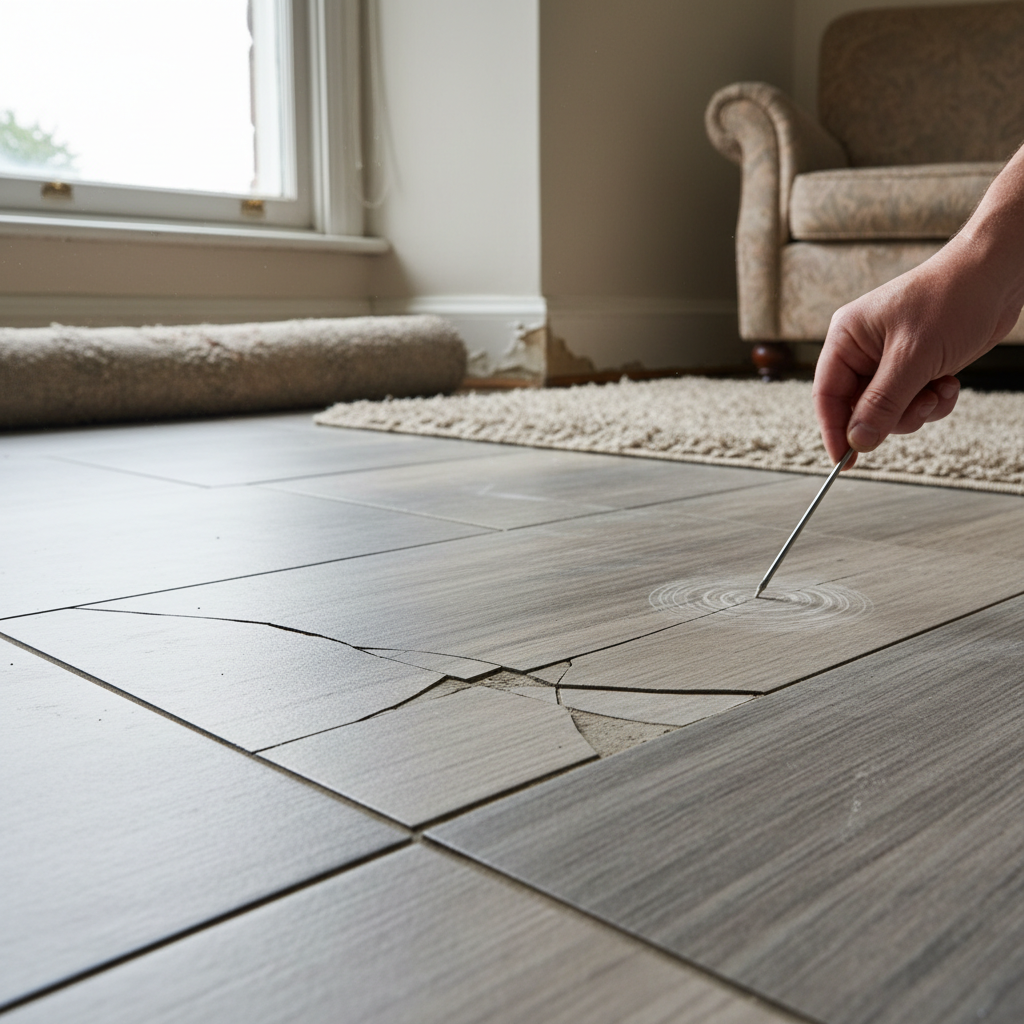
Walking across a newly tiled kitchen in Cheshire recently, the distinct drum-like note underfoot was immediately obvious before I even opened my tool bag. The homeowner had noticed fine fractures spidering across the grout lines within six months of completion, followed by several large-format porcelain units shearing completely. Cracked tiles and hollow-sounding floors are among the most frequent issues I inspect, and identifying why they failed requires methodical testing rather than guesswork.
Tile failures rarely happen because the ceramic or porcelain itself was defective. Modern tiles are generally robust products manufactured to consistent factory controls. When a tile cracks or loses its bond, the breakdown almost always originates in the substrate below, the method of fixing, or environmental conditions during installation.
Investigating cracked tiles and hollow-sounding floors
When called out to inspect an installation, my first task is non-destructive acoustic sounding. Lightly tapping across the tiled area with a wooden dowel or specialized nylon hammer reveals the extent of debonding. A well-bonded tile produces a dull, solid click. A tile that has lost its bond to the adhesive bed, or where the adhesive has detached from the screed, returns a hollow ring.
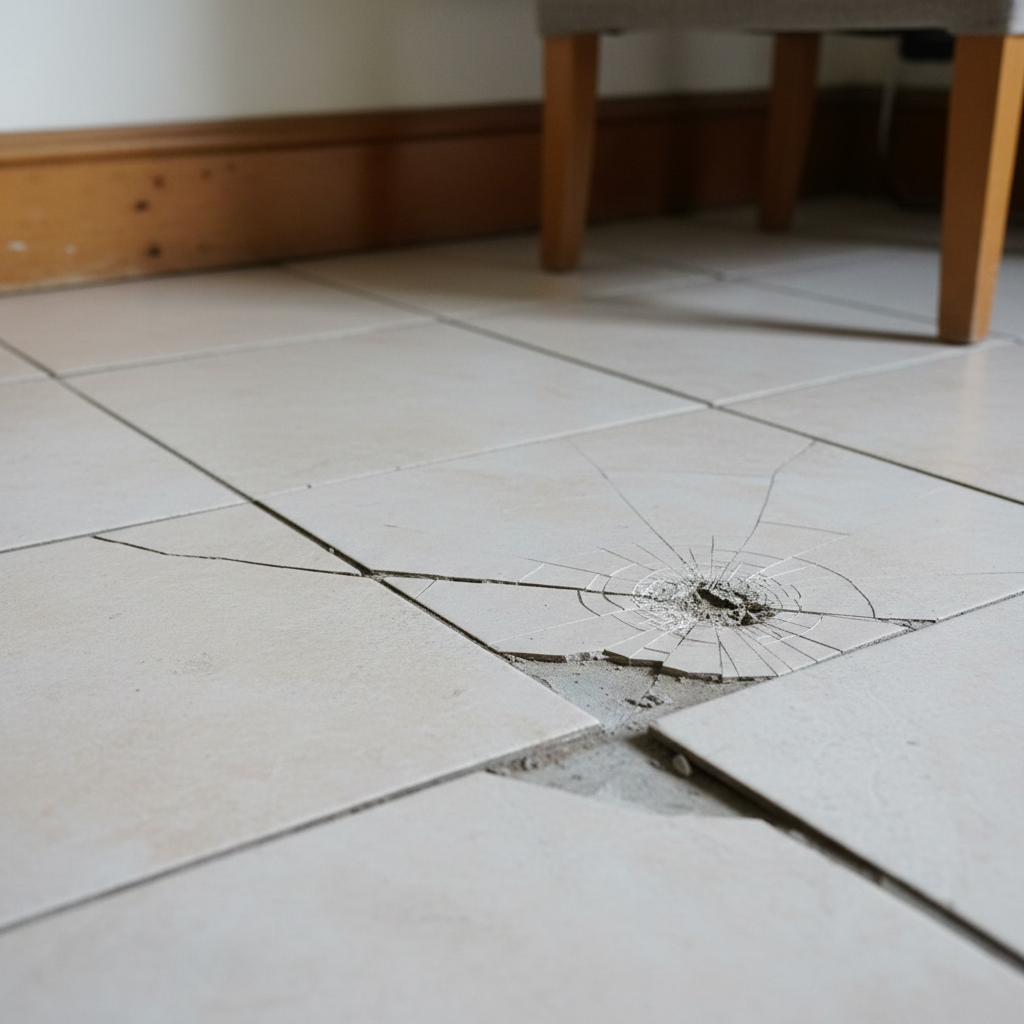
When examining cracked tiles and hollow-sounding floors on site, I look closely at the fracture lines. A crack running diagonally across the body of a tile often indicates point loading or localized voiding in the adhesive bed beneath. When a continuous crack runs through multiple adjacent tiles and through the grout lines in a straight row, it almost invariably mirrors a crack or joint in the underlying concrete base or screed.
Where permission is granted to lift a broken tile, the failure plane provides clear physical evidence. In many disputed installations, the back of the lifted tile is clean, showing defined ridges of dried adhesive that never collapsed flat. Under British Standards for wall and floor tiling, floor tiles require a solid bed of adhesive beneath them. Spot-fixing with dabs or applying ribbed adhesive without firmly bedding the tile down leaves substantial air voids. These voids weaken the tile under foot traffic and create the familiar drum-like sound.
Sub-floor deflection and missing movement joints
Timber sub-floors introduce their own set of challenges. Ceramic and porcelain do not tolerate bending forces. When a timber floor flexes under normal foot traffic, known technically as deflection, rigid tiles cannot accommodate the movement. The grout cracks first, followed swiftly by debonding and fractured tiles.
During an inspection, I check joist spans, board thickness, and whether an appropriate uncoupling membrane or cement-based backer board was installed. Laying tiles directly over standard tongue-and-groove floorboards or flexible plywood without suitable reinforcement regularly leads to debonding.
Movement joints are equally misunderstood. All buildings move slightly through thermal and moisture changes, and tiling installations expand and contract. Perimeter expansion gaps around skirting boards and intermediate movement joints in larger floor spans are required by British Standards. When an installer butts tiles tightly against walls or fails to install movement joints across structural expansion breaks in the screed, lateral compressive stress builds up. In warm weather or when underfloor heating activates, the tiled surface expands, tents upward, and breaks free from the floor.
Moisture and humidity readings that settle disputes
While adhesive coverage and deflection are visible to the naked eye, sub-floor moisture and humidity readings are what decide most formal disputes. Anhydrite or calcium sulphate screeds, which are widely poured over underfloor heating pipes, are particularly vulnerable to moisture errors.
During site investigations, I carry calibrated surface moisture metres and non-invasive impedance equipment to map moisture patterns across the floor. Where a screed failure is suspected, I use surface hygrometer boxes sealed to the screed face to measure the equilibrium relative humidity (ERH) over a defined period.
In several recent claims, builders had laid tiles over semi-dry screeds to meet tight handover programmes. If a calcium sulphate screed is tiled over before its relative humidity drops to the level specified in industry standards, residual moisture reacts chemically with standard cementitious tile adhesives. This reaction forms an expansive mineral layer known as ettringite at the bond line. The ettringite destroys the mechanical bond, which often results in cracked tiles and hollow-sounding floors months after handover.
Similarly, where concrete sub-floors lack an effective damp-proof membrane, moisture vapour rising from the ground degrades adhesive interfaces or causes levelling compounds to break down into powdery dust. Recording accurate relative humidity and moisture content readings at the time of inspection provides objective data that leaves little room for argument between homeowners, contractors, and insurers.
When to call an independent inspector
If you have tiles that sound hollow, show hairline fractures, or have lifted from the sub-floor, obtaining an objective opinion is the safest first step. An independent report provides clear, factual evidence identifying whether the issue stems from structural movement, inadequate adhesive transfer, poor substrate preparation, or trapped moisture.
I provide impartial floor inspections across the whole of the UK for homeowners, contractors, and legal teams, and my work is trusted by the Furniture and Home Improvement Ombudsman. You can review my Silver, Gold, and Diamond inspection packages to find the right level of assessment for your dispute, or contact me directly to discuss your floor.
Have a flooring problem of your own?
We are independent UK flooring inspectors. Tell us about your case and we will recommend the right inspection package, with a fixed fee in writing before any work begins.