
Investigating DPM Failure and Rising Moisture Under New Floors
Explaining DPM failure and rising moisture under new floors. An inspector's guide to why it happens and the common myths you might be told.
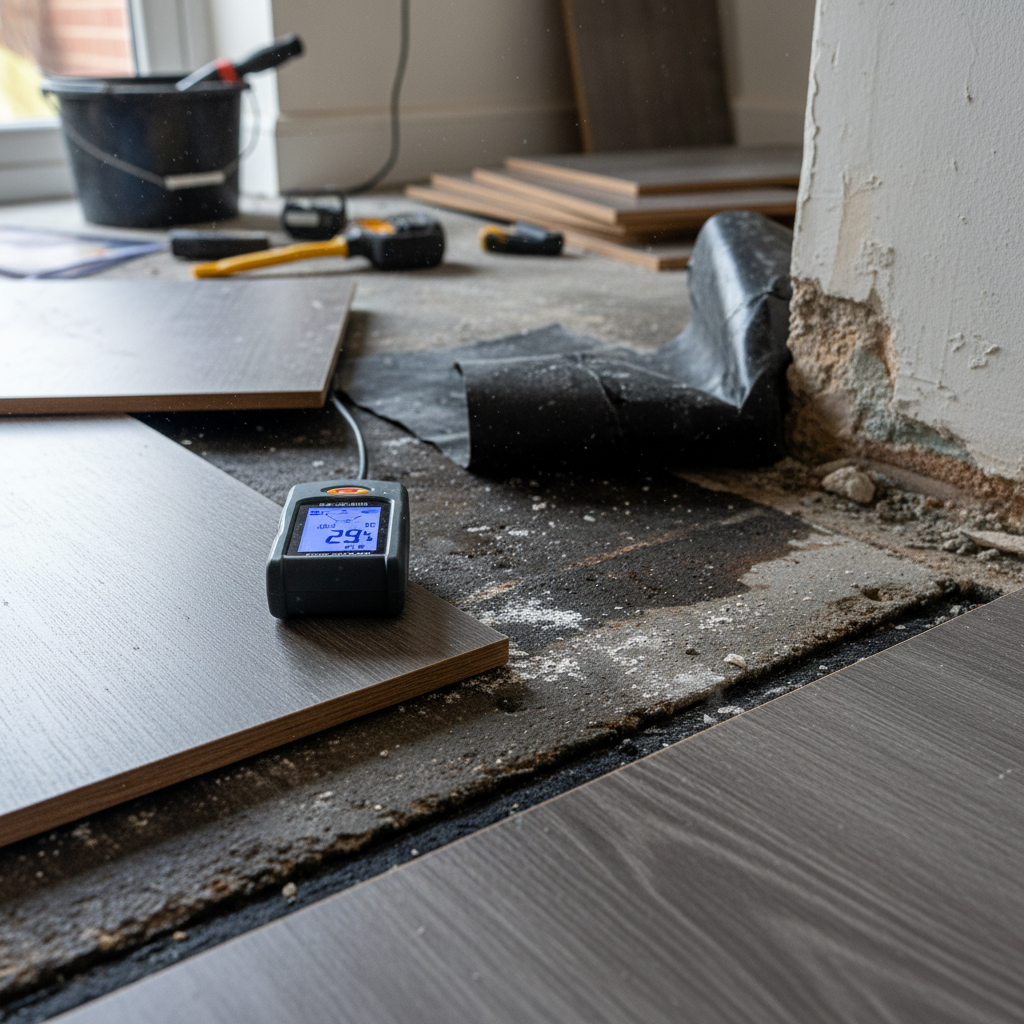
It is a situation I encounter frequently. A homeowner has a new floor, perhaps an engineered wood or a laminate, and within months it has begun to lift, cup, or show signs of swelling at the joints. The immediate assumption is often that the flooring product is faulty. However, in my experience, the problem frequently lies beneath the surface. Investigating potential DPM failure and rising moisture under new floors is a significant part of my work, and it often reveals an issue with sub-floor preparation, not the floor covering itself.
What is a DPM and why is it essential?
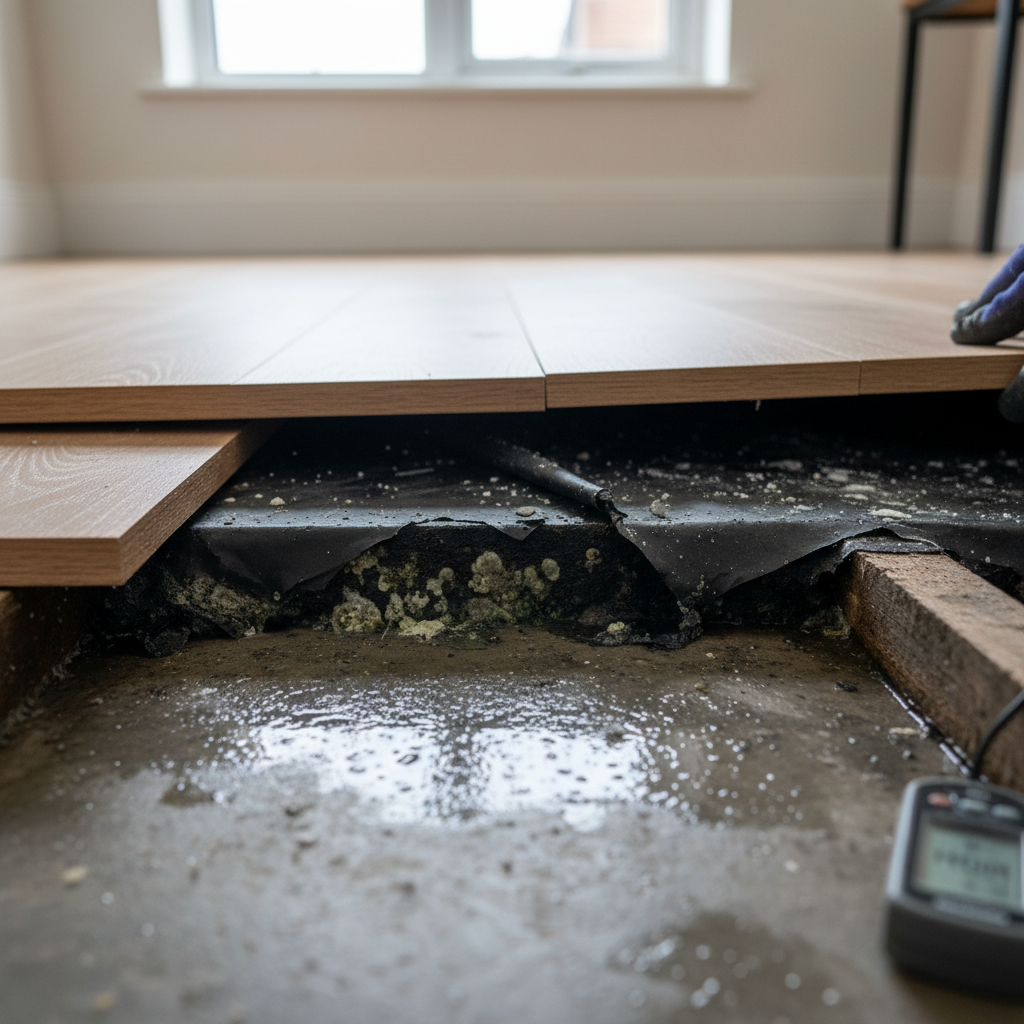
A Damp Proof Membrane, or DPM, is a barrier. It is designed to stop moisture from passing from one place to another. In flooring, its primary job is to protect the floor covering from moisture held within the sub-floor. Concrete and screed sub-floors, particularly on the ground floor, can act like a sponge. They may look and feel dry to the touch, but they can hold and transmit a significant amount of water vapour. Without a suitable barrier, this moisture will travel upwards and be absorbed by the flooring system.
British Standards, such as BS 8203 which covers resilient floor coverings, provide clear guidance on the need for effective DPMs. The principle is simple: the floor covering must be isolated from sub-floor moisture. This is usually achieved with a physical sheet membrane laid before a screed is poured, or more commonly for retro-fit work, a liquid-applied DPM painted onto the prepared screed before the flooring is installed. If this step is missed or not performed correctly, problems are almost inevitable.
Common myths about damp from the sub-floor
When a floor starts to fail due to moisture, homeowners are sometimes told things that can be misleading. Based on my site findings, these are a few common claims I am asked to investigate.
One is that the homeowner's cleaning regime is to blame. While excessive surface water can certainly damage a floor, the pattern of damage from rising moisture is distinct. Cupping in a wood floor, where the edges of the boards are higher than the centre, is a classic sign of a moisture imbalance. The board is wetter on the bottom than on the top. This points towards moisture coming from below, not from a damp mop on the surface.
Another frequent statement is that the installer 'did not see any damp'. A visual inspection is not a reliable method for determining the moisture condition of a concrete sub-floor. A screed can appear perfectly dry while having a high internal moisture content. This is why professional installers are expected to test for moisture using calibrated equipment before proceeding.
Finally, there is the belief that an underlay with a 'built-in DPM' is sufficient. These products are often just vapour checks or vapour barriers. They can resist a certain amount of vapour, but they are not a substitute for a full DPM system, especially on a ground floor concrete base or where moisture levels are unknown or high. In my professional opinion, relying on these alone is a significant risk.
Investigating DPM failure and rising moisture under new floors
When I am called to a site, my approach is methodical and evidence-based. The objective is to establish the facts. My initial assessment involves a non-destructive survey using a professional pinless moisture metre. This gives an overview of the affected areas and helps to identify patterns.
To get definitive data, however, a destructive test is usually necessary. This is done as discreetly as possible, perhaps by lifting a single board in a low-traffic area or under a large piece of furniture. Once I have access to the sub-floor, I can take direct measurements.
My primary tool for this is a digital hygrometer, used in accordance with British Standards. This involves placing a sealed box or hood onto the surface of the concrete to measure the Relative Humidity (RH) of the air trapped within it. After a period of acclimatisation, the reading tells us the moisture condition of the sub-floor. This is not an opinion, it is a quantifiable measurement taken at the time of inspection.
What the findings mean for your claim
If the hygrometer reading shows the sub-floor RH is above the accepted threshold for the flooring that was installed (typically 75% RH for many products), it provides strong evidence. It indicates that the sub-floor was, and remains, too damp for the floor covering to have been installed without an effective DPM.
Based on these findings, a report can be produced that clearly details the methods used and the results obtained. No evidence is usually identified to suggest a manufacturing fault with the flooring product itself. Instead, the evidence points towards an installation failure: the omission of a necessary DPM or the failure to confirm the sub-floor was sufficiently dry before commencing work. This information can be fundamental in discussions with the retailer or installer, as it clarifies the likely cause of the failure.
When to call an independent inspector
If your new floor is showing signs of moisture damage and you are in dispute with your supplier, a professional, evidence-based report is the next step. My inspection reports provide the objective data needed to determine the cause of the problem, which can help to resolve the complaint.
I provide inspection services across the entire United Kingdom and am a trusted inspector for the Furniture and Home Improvement Ombudsman. Reports are offered in several formats, including our Silver, Gold, and Diamond inspection packages. To discuss your specific issue or to book an inspection, please get in touch via my contact page.
Have a flooring problem of your own?
We are independent UK flooring inspectors. Tell us about your case and we will recommend the right inspection package, with a fixed fee in writing before any work begins.